International Perspectives on Solidarity-Based Cultural Production
Achtung, dieser Workshop wird in Englisch sein.
When discussing solidarity-based cultural production in Germany, an international perspective is essential. Practices that have already been successfully implemented elsewhere could soon become viable here as well, particularly when it comes to alternative forms of governance and organisation.
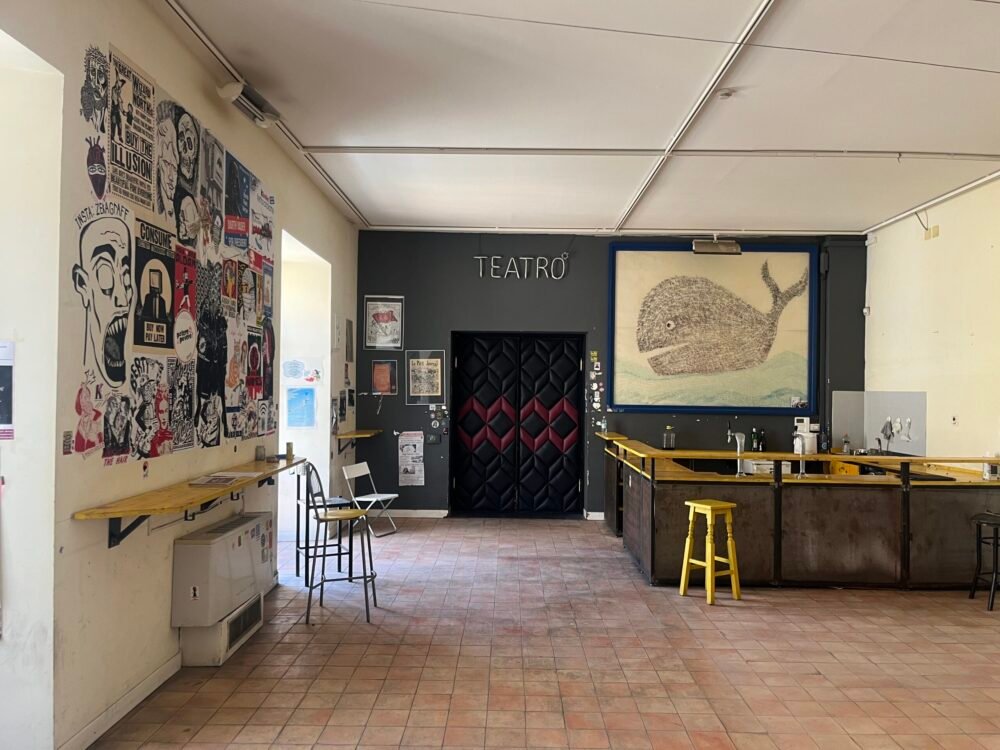
The workshop will include short inputs by Gabriella Riccio (L’Asilo, Naples) and Asli Varol (Vollgut Berlin). L’Asilo in Naples is a self-managed, independent centre for artistic, cultural and social production. It emerged in 2012 through the occupation of a former orphanage by artists and activists and is widely recognised as a pioneering cultural commons project. Its model of self-governance has been formally recognised by the city through a Commons–Public-Partnership and has inspired the development of further cultural commons in Naples. The Vollgut site in Neukölln is a former brewery complex (Berliner Kindl-Brauerei, 1926–2005) that has been owned by the Edith Maryon Foundation since 2016. In 2023, the VOLLGUT eG cooperative was founded to develop the last large undeveloped building on the site — around 40,000 sqm — using circular construction methods, affordable commercial spaces, and a community fund for the neighborhood.
In this workshop, we explore how collective decision-making and care are interconnected. Who makes decisions, and how are they legitimised? Who takes on the often invisible work of communication, conflict resolution or emotional support? How can we prevent these responsibilities from falling disproportionately on a few individuals? Together, we will discuss how governance models such as consensus-based decision-making, sociocratic circles or hybrid forms of participation can work in practice, and how care can be more fairly distributed and structurally embedded. How can we create structures that are viable in the long term without overburdening those involved?
Inputs
Gabriella Riccio, Ex Asilo Filangieri, Naples
Gabriella Riccio, choreographer and performer working at the intersection of artistic creation and cultural activism. With a background in political studies, she has engaged in the defence of cultural rights, supporting practices of participatory democracy in self-governed cultural spaces and the movement for the commons. She contributed to the drafting of the Declaration of Urban Civic and Collective Use instituting L’Asilo-Ex Asilo Filangieri as the first formally recognised common in the City of Naples. Gabriella is co-founding member of the Institute of Radical Imagination, and contributed to Museum of the Commons with L’internationale confederation. Regularly invited by art schools, universities, EU cultural networks and activists meetings. She published articles on the intersection of aesthetics, ethics and politics in contemporary prefigurative practices. linktr.ee/gabriellariccio
Aslı Varol, Vollgut Berlin
Aslı Varol is an architect and project developer, as well as a board member of VOLLGUT eG in Berlin-Neukölln. In this role, she is responsible for the participatory development of the former Vollgut warehouse on the KINDL site into a public-interest-oriented cultural, commercial and community centre. Her work focuses on circular construction, long-term affordable spaces for culture and social initiatives, and urban development geared towards local well-being.
Moderation
Benedikt Stoll – Urbane Praxis e.V.
Sarah Waterfeld, Falk Lörcher – Union für Cultural Commons
Janet Merkel – TU Berlin, Institut für Stadt- und Regionalplanung, Fachgebiet Stadt- und Regionalplanung
Um Anmeldung unter diesem Link wird gebeten.
Der Workshop ist Teil der transdisziplinären Workshop-Reihe „Solidarische Kulturproduktion“. In deren Mittelpunkt stehen kollektive und gemeinwohlorientierte Organisationsformen, solidarische Finanzierungsansätze sowie Governance-Praktiken, in denen Mitbestimmung und Sorgearbeit zusammengedacht werden. Die Reihe wird von Benedikt Stoll (Urbane Praxis e.V.), Sarah Waterfeld, Falk Lörcher und Isabella Dahm (Union für Cultural Commons) und Janet Merkel (TU Berlin, Fachgebiet Stadt- und Regionalplanung) organisiert. Das Projekt wird finanziert mit Mitteln der TD-Lab-Förderung der Berlin University Alliance.